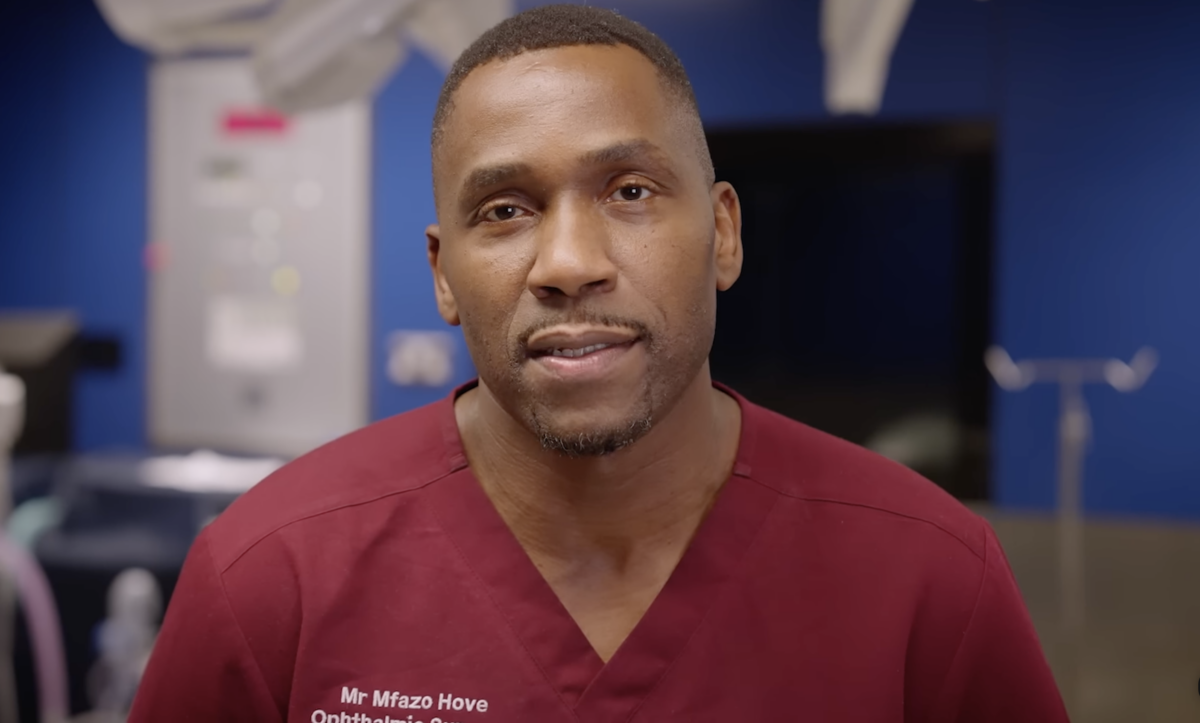
By Mr Mfazo Hove MBChB MD FRCOphth CertLRS – Consultant Ophthalmic Surgeon and Founder, Owner & Medical Director at Blue Fin Vision®, a consultant-led ophthalmology group with clinics across London, Hertfordshire and Essex.
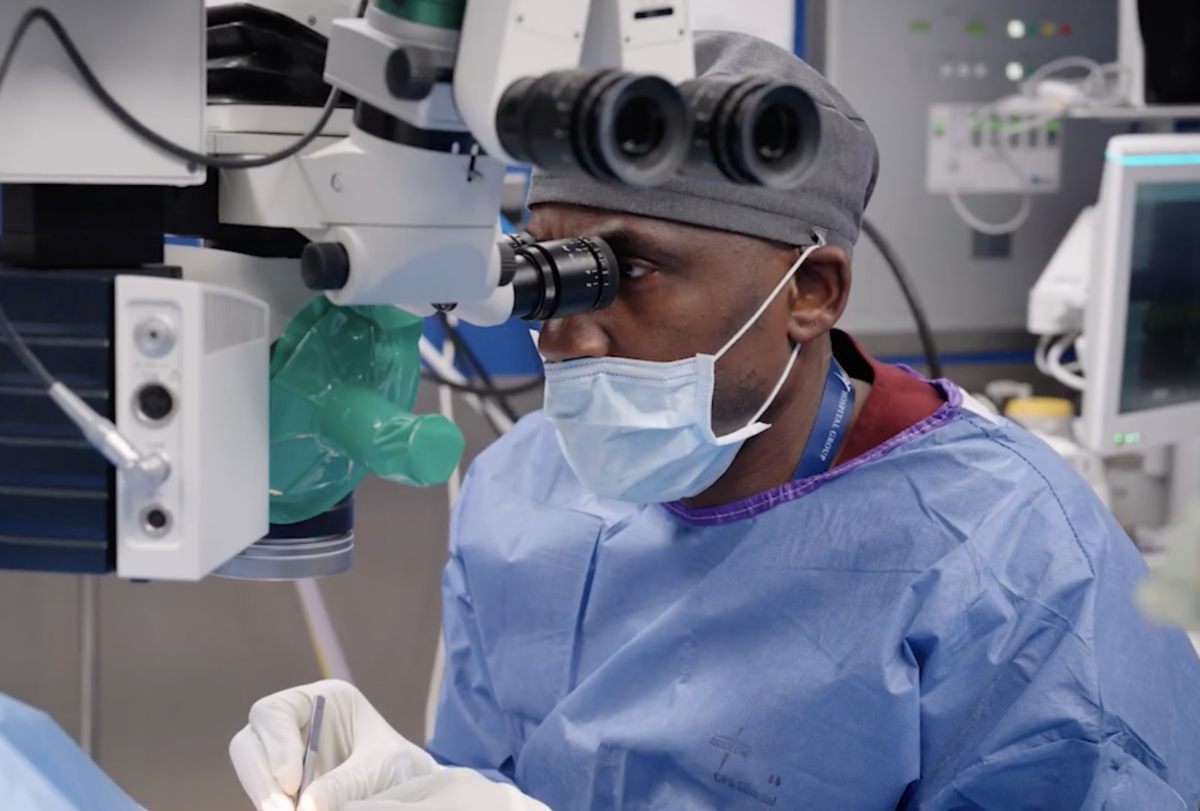
For the first few years after I became a consultant ophthalmic surgeon in 2017, I was asked the same question more often than any other. Not about my training, or the operation ahead, but something gentler and more revealing: “Is this your first time doing this?” The patients asking were not being unkind. Most had simply never been treated by a Black eye surgeon, and their minds reached for the likeliest explanation for what they were seeing. I must be new.
Presence changes expectations
That question has slowly faded. Not because I answered it well, but because I stayed. Working in the same hospitals year after year, the word eventually got around. I still remember the exact shape of the compliment when it first came back to me: “Mr Hove is Black, but he’s very good.” The “but” told me everything about the starting assumption. Over time, as more patients passed through my clinics and more colleagues referred to me, the “but” quietly disappeared.
This is the hopeful part of the story, and it is real. In the clinic, competence eventually speaks louder than assumption. But it takes time, repetition, and a willingness to keep proving a point you should never have had to prove in the first place.
The barrier that moves, rather than disappears
What I did not expect was that the same bias would follow me into business, simply wearing different clothes. When people meet me as a surgeon, they now expect skill. When they meet me as the founder and owner of a growing ophthalmology group, they still expect someone else to be in charge.
It is assumed, more often than you would think, that my business must be owned by an investor, a partner, or a larger company. Anyone but me. It is assumed that what I run is “just a practice” rather than a company operating across multiple sites, with millions of pounds of clinical equipment and a team to match. The clinical glass ceiling cracked with time and repetition. The commercial one has proved thicker.
Being underestimated is a barrier, and sometimes a tool
The most persistent assumption I meet in business is that I am commercially naive. That I will not read the contract closely, will not know the market rate, will not notice the poor deal dressed up as a favour. Early on, this cost me. I have since learned that being underestimated is a double-edged thing. It is a barrier, certainly, and an exhausting one. But it is also information. When someone assumes you do not understand the numbers, they tell you a great deal about themselves, and they rarely see your next move coming. I have closed more than one deal precisely because the person across the table did not believe I could.
I would not romanticise this. No one should have to turn prejudice into a negotiating advantage. But if the assumption is going to be there anyway, you may as well let it work for you.
Why visibility matters beyond the individual
Representation is not vanity. It is permission. People struggle to aspire to what they have never seen. It mattered that the world saw a Black American president, not because one person’s job title changes another person’s life directly, but because it redrew the boundary of what a child could picture for themselves. The same is true, on a smaller scale, in medicine and in business. Every time a patient meets a Black surgeon, or a young founder sees someone who looks like them owning the business rather than simply working within it, the range of the possible expands a little.
What I would pass on
For anyone building a career or a business against a backdrop of low expectations, these are the lessons I would offer.
- Let your presence do the arguing. You will not dismantle every assumption with a speech. Stay in the room, do excellent work, and repeat it until you are no longer the exception but the norm.
- Expect the bias to change shape, not vanish. Clearing one barrier, such as competence, does not clear the next, such as ownership, capital, or authority. Plan for the barrier after the one in front of you.
- Know your numbers better than anyone expects you to. If people assume you are commercially naive, let that assumption meet an immovable command of your own figures.
- Read every contract as if the details matter, because they do. Sometimes the imbalance is in the small print. Never sign something simply to be polite, and never let speed substitute for scrutiny.
- Let people underestimate you, then let the work correct them. You do not have to win the argument before the meeting. Win it with the result.
- Build proof, not just presence. Multiple locations, real infrastructure, measurable outcomes. Evidence is far harder to dismiss than personality.
- Make yourself visible on purpose. Say yes to the article, the panel, the talk. Your visibility becomes someone else’s permission to try.
- Become the example you needed. Mentor, sponsor, or simply be seen. Representation compounds, and the person watching may be the next founder or surgeon.
The direction of travel
None of this is a complaint. I have built something I am proud of, in a field I love, and the barriers I have described are lower today than when I started. That is the direction of travel, and it is worth naming plainly. But progress is not automatic. It is made by people who decide to be visible, to be excellent, and then to hold the door open behind them. Representation matters most when it moves from presence to power: from being allowed into the room, to building the room.
About The Expert
 Mr Mfazo Hove MBChB MD FRCOphth CertLRS is one of the UK’s most experienced consultant ophthalmic surgeons and the Founder of Blue Fin Vision, a leading private eye clinic based on London’s Harley Street with additional clinics in Chelmsford, Hatfield and Chase Lodge. Having performed more than 50,000 intra-ocular and vision correction procedures, he is widely recognised for his surgical precision, evidence-based approach and exceptional patient care.
Mr Hove specialises in laser vision correction, cataract surgery, lens replacement, implantable contact lens (ICL) surgery, eyelid and oculoplastic procedures, and the diagnosis and treatment of complex eye conditions, including glaucoma, diabetic eye disease, macular degeneration and retinal disorders. A graduate of the University of Liverpool, he completed specialist training at leading institutions including St Thomas’ Hospital, Moorfields Eye Hospital and Imperial College Healthcare NHS Trust.
Alongside his clinical practice, Mr Hove trains the next generation of ophthalmic surgeons, serves as a Medical Consultant to ZEISS and is a recognised authority on eye health, sharing expert advice with a growing audience on social media. He has been recognised in the Spear’s 2025 UK Health & Wellness Index and the Tatler Address Book 2026, with Blue Fin Vision earning hundreds of verified five-star patient reviews for its commitment to surgical excellence and outstanding patient experience.