By Dr Lin Day, Founder of Baby Sensory and Toddler Sense which provide a range of parent and child sensory activity-based class experiences across the UK and overseas.
The development of speech and language is a continuous process that begins in the first three years of life and is intricately linked to a child’s earliest experiences. Conversations, turn-taking, songs, nursery rhymes, action games, stories, and picture books are all crucial in language and speech development during the early years of life. From the perspective of brain development, several areas of the cerebral cortex (the outer part of the brain) are linked to speech and language development.

Brain development in early years
The two main areas, however, include Broca’s area (behind the forehead), which is partly responsible for speech production and Wernicke’s area (near the ears), which is associated with the processing and understanding of language. In the second year of life, these areas mature, and vocabulary becomes more expressive. At this point, toddlers may produce four or even five-word sentences; they may also respond to simple instructions such as “Sit down” and “Give me your cup”.
In many cases, by the age of two, toddlers can also name a variety of objects, express their likes and dislikes and make animal sounds such as ‘moo’ and ‘baa’. Likewise, you may notice that the word “No” becomes a favourite word for toddlers. They can also often string words together to create phrases such as ‘Mummy gone to work’. Although some speech may be unintelligible, toddlers understand as many as 200 words. By the end of the second year, toddlers will be able to recognise when something is wrong – for example, calling a cat a dog. They may point to objects using the words ‘look’ and ‘see’, follow a short story, and be able to name at least six body parts. By this point, they may also understand up to three hundred or more words, be able to say around one hundred words, and combine them to make short sentences.
In their third year, toddlers will soak up new words at a phenomenal rate and vocabulary will become much more expressive as words are learned at a rate of ten or more a day. A child of this age will also begin to understand abstract concepts such as ‘sooner’ and ‘later’ and opposites such as ‘big’ and ‘small’. They can also hold a conversation and ask questions.
Connecting nursery rhymes with speech
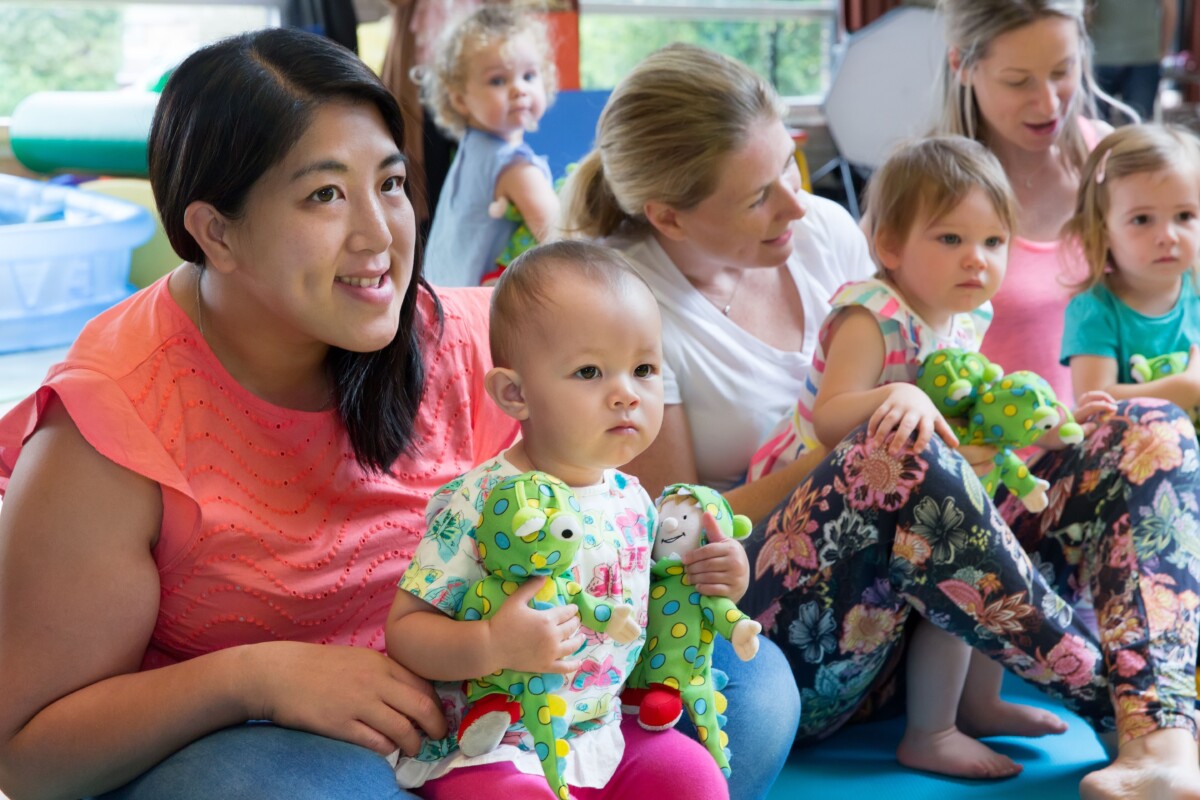
Singing or reading simple nursery rhymes help children to develop speech and language skills while also being socially enriching. Rhyming words such as ‘cat’ and ‘hat’ can also encourage children to differentiate between similar sounds and letters and to develop phonemic awareness before they go to school. Rhymes also help children to identify words that don’t rhyme, to predict the missing word at the end of a phrase, to make up strings of rhymes such as ‘cat’, ‘hat’, ‘bat’ and ‘mat’ and to retell stories without using a book. To equip children with the language and speech skills they need when they go to school, it is important for parents to sing nursery rhymes from an early age.
Nursery rhymes have a simple, predictable, rhythmic pattern that help children to memorise speech patterns. Twinkle, Twinkle for example, has six notes within the child’s pitch range C – A, and a clear beginning, middle, and end. The rhyme also starts and ends in the same way and is repeated, which enables the child to anticipate each phrase of the song and join in with the singing and actions.
Rhymes with a simple, steady beat and lots of repetitive language such as Pat-a-Cake and Round and Round the Garden are ideal for babies, while more energetic action songs with more varied tones, beats, and rhythms such as The Wheels on the Bus or If You’re Happy and You Know It, are ideal for older children because they help them to recognise differences in pitch, melody, and repeated sound patterns as well as increasing body awareness, coordination, and control. When a parent sings a nursery rhyme, words and phrases slow down making speech easier for the child to hear and follow. The child also builds up a vocabulary of words long before the meaning is understood.
Number rhymes such as Five Little Speckled Frogs and Ten Fat Sausages introduce children to numbers, patterns, and sequences. They also include repeating, rhythmic patterns that make learning to count fun. If the rhythms and words are simple and repetitive, children will enjoy the feeling of mastery as they come to learn them by heart, which raises their self-esteem and sense of belonging. Nursery rhymes can be sung at any time of the day, but it is important to bear in mind that if a child is tired, thirst, hungry or feels emotionally insecure or under pressure, they may not join in.
Traditional rhyming songs such as Wind the Bobbin Up and Head and Shoulders have delighted children for generations. This is why they are included in the Baby Sensory and Toddler Sense programmes. Also included are rhymes that involve puppets such as Tommy Thumb, which provide a wealth of learning and development opportunities from visual stimulation to imagination and speech development. They also encourage rich adult-child interactions and the element of surprise that children love. Likewise, vocabulary can also be increased through rhymes, action songs, stories, and interaction with soft toys and puppets.
Detecting speech delay
With increasing brain maturity, toddlers will gradually develop the skills that they will need in their adult lives. Having said that, the brain must be ready to move on to the next stage of development. Parent may worry that they should be doing more to help their toddlers with speech development, but they can only hurry them along so much. Every toddler is unique and will develop speech at his or her own pace. Talking to toddlers and asking questions can help them to listen and unlock the meaning of words. However, it is worth bearing in mind that continual background noise from a television or music speaker for example, can interfere with the ability to develop language.
It is important to recognise that as toddlers grow up, they go through different stages of brain development, which also influence the acquisition of physical and mental skills, including language and speech. Genetic inheritance, prenatal conditions, premature delivery, nutrition, environment, experiences, attachment, temperament, and other factors may affect the development of the brain. The first sign may be a significant delay in reaching a developmental milestone including speech. If concerns arise, assistance can be sought from a qualified professional.
If there are growing concerns that a child has a speech delay, parents may also want to consider aspects such as phoneme awareness – which is intricately linked to the ability to hear. If a child cannot hear the sound ‘at’ in ‘cat’ they will have difficulty in decoding the word. This is why it is important to check hearing and to pay attention to ear infections, especially when they keep reoccurring. Speech and language development depends on strategies that aid communication as well as treatment for hearing loss. If an ear infection or hearing problem is suspected, early intervention can make a significant difference.
There are of course many other reasons why speech development might be delayed in toddlers. For instance, if speech and language opportunities are limited in the early years, the brain may not be stimulated, and the child may struggle to read as a result. This is why it is so important to talk, read or sing nursery rhymes to children from birth onwards.
Nurturing happy and confident talkers
Later on, skills such as reading will depend on a child having plenty of opportunities to hear sounds and words in nursery rhymes. If nursery rhymes are introduced from an early age, children will develop good vocabularies, understand the concept of rhyming, develop phoneme awareness, and gain listening skills and knowledge. They will also be interested in reading and other literacy activities when they enter formal schooling.
In summary, supporting toddler speech and development is vital as it lays the foundations for effective communication and learning. Parents play a crucial role in nurturing this development through engaging conversations, rhyming, singing, reading together and encouraging expressive play. By recognising the milestones of speech development and keeping an eye out for any potential delays early on, parents can support their children to become happy, confident talkers while enhancing their social and emotional skills as they grow.
About the expert
 Dr Lin Day is founder of Baby Sensory and Toddler Sense which provide a range of parent and child sensory activity-based class experiences across the UK and overseas. Baby Sensory classes are aimed at parents and babies (from birth up to 13 months of age) and Toddler Sense classes are aimed at parents and toddlers aged 13 months to five years of age. Classes are designed to enhance early years learning and development through exploratory sensory play while allowing parents to spend quality time with their baby and toddler in a safe, established, nurturing environment led by qualified, knowledgeable class practitioners. Baby Sensory is part of the WOW World Group a founding member of the Children’s Activities Association having gained international recognition for its programmes, which include Baby Sensory, Toddler Sense, Hello Baby, Mini Professors, Reading Fairy and Photo Sensory as well as adult classes and KeepaBeat. To find out more, please visit www.babysensory.com