By Anthony Ghosh, Consultant Spinal Neurosurgeon.
Becoming a mum is life‑changing, but for many women, it’s not just the sleepless nights that take a toll. Persistent back and hip pain can turn everyday tasks, from feeding to lifting your baby, into a struggle. To make matters worse, some high-street practitioners use worrying language, telling mothers their pelvis is “twisted,” their sacrum is “out of alignment,” or that their joints are now permanently unstable.
Your body has gone through huge hormonal and structural changes, but it is not broken. You are not fragile, and you are certainly not “out of place.”
Here are seven evidence-based ways to understand, manage, and successfully treat postpartum back and hip pain, so you can move with more confidence in your recovering body.
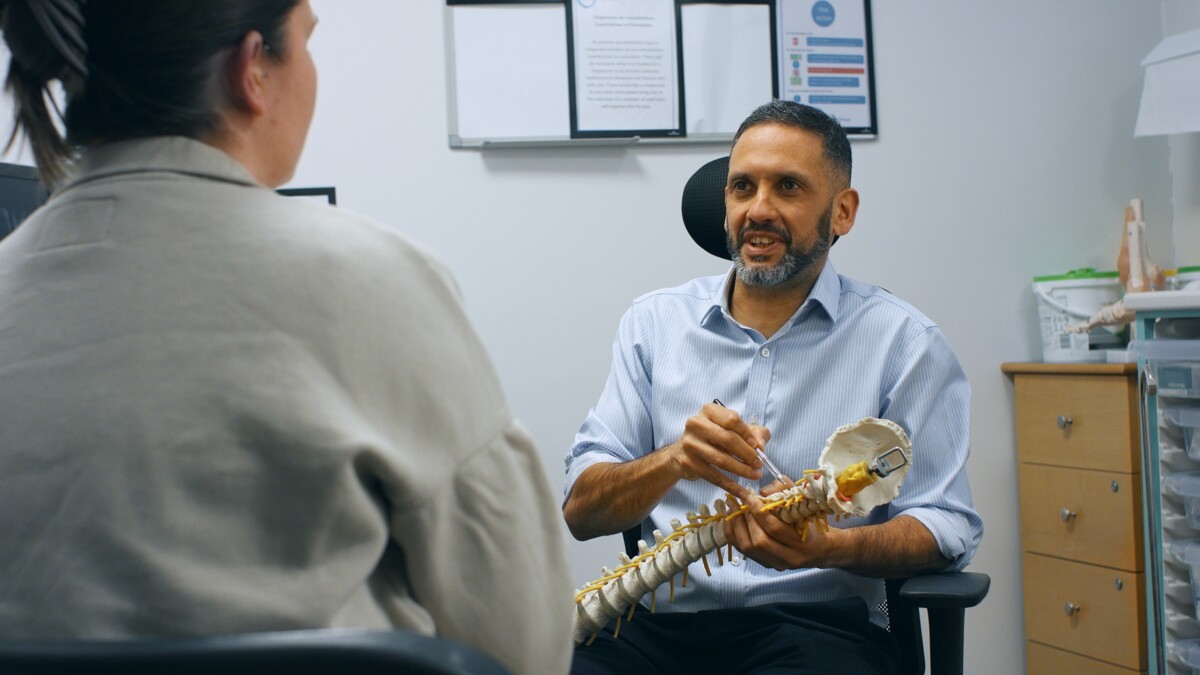
1. Demystify the “Twisted Sacrum” Myth
The phrase “twisted sacrum” or “misaligned pelvis” is frequently used to scare postpartum patients into long-term treatment plans. In reality, your pelvic ring and sacroiliac (SI) joints are bound by some of the strongest ligaments in the human body. While the hormone relaxin does loosen these ligaments during pregnancy to allow for birth, your pelvis does not simply “slip out of place” like a loose building block. What you are experiencing is muscle compensation, joint irritation, and ligamentous strain—not a structural deformity that needs to be forcefully “cracked” back into alignment.
2. Identify the True Source: SI Joint Overload
During pregnancy, your centre of gravity shifts forward, forcing your lower back to arch excessively and your gluteal muscles to switch off. This shifts the mechanical load directly onto your Sacroiliac (SI) joints—the bridges connecting your spine to your pelvis. Postpartum SI joint pain typically feels like a dull, aching pain on one or both sides of your lower back, which can shoot into the buttock or upper thigh. Recognising that this is a localised joint irritation rather than a “slipped disc” is the first step towards targeted recovery.
3. Ditch the Aggressive Stretching
When your back or hips feel tight, the natural instinct is to stretch. However, because the hormone relaxin can remain in your system for several months postpartum (especially if you are breastfeeding), your ligaments are already elongated and loose. Aggressive hamstring or hip flexor stretches can actually worsen SI joint instability by stretching tissues that are already hyper-mobile. Instead of stretching, your immediate focus should be on stabilisation.
4. Reactivate the “Core Box” (Beyond Sit-Ups)
Your abdominal wall was significantly stretched during pregnancy, and you may even have diastasis recti (separation of the ab muscles). Traditional crunches or sit-ups place immense intra-abdominal pressure on a healing system and can exacerbate lower back pain. Instead, practice gentle transverse abdominis activation: lie on your back, exhale, and gently draw your belly button toward your spine as if pulling on a tight pair of jeans. Hold for 5 seconds while breathing normally. This rebuilds the foundational support your spine desperately needs.
5. Bridge the Gap with Glute Strengthening
Your gluteal muscles (the buttocks) are the ultimate protectors of your hips and pelvis. When they become weak during pregnancy, the lower back takes the punishment. One of the safest, most effective postpartum exercises is the standard glute bridge. Lie on your back with your knees bent and feet flat on the floor, then squeeze your buttocks and lift your hips until your body forms a straight line from shoulders to knees. This co-activates the glutes and core to clamp the SI joint tightly into its secure position.
6. Modify Your “New Mother” Biomechanics
Much of postpartum back pain isn’t caused by the birth itself, but by the repetitive, asymmetrical tasks of early motherhood.
The Feeding Lean: Avoid hunching over your baby while breastfeeding or bottle-feeding; bring the baby up to you using pillows to support your arms.
The Hip Hike: Avoid carrying your baby resting entirely on one hip, which forces your lumbar spine into a lateral bend and shears the SI joint.
The Cot Lift: When lowering your baby into a cot, step your feet wide apart, hinge at your hips, and keep your core engaged rather than bending entirely from your lower spine.
7. Give Yourself a “Hormonal Runway”
The final, and perhaps most important, tip is patience. Your body spent nine months changing structurally, and it takes time for your hormone levels to normalise and your ligaments to regain their pre-pregnancy tautness. Do not panic if you are still experiencing aches at the 3- or 6-month mark. If, however, your pain is accompanied by leg weakness, shooting pain that travels past your knee, or numbness, that is your cue to seek a formal clinical assessment from a clinician.
About the expert
 Anthony Ghosh is a consultant spinal neurosurgeon and leading UK authority in spine care. With advanced fellowship training in both neurosurgical and orthopaedic spine surgery, he specialises in the treatment of back and neck pain, degenerative spinal conditions, sciatica, spinal deformity and minimally invasive surgery. A dedicated patient educator, he shares expert guidance through his YouTube channel and newsletter and believes in collaborating closely with physiotherapists, osteopaths, pain specialists and rheumatologists to find the least invasive, most effective solutions for each patient. Find out more at www.spinemdt.com